 Ali Thameem
Liverpool fans must have had mixed feelings upon hearing the announcement that their beloved club was to part ways with Arne Slot.
The Dutchman had opened the door to their 20th league title just 12 months ago, but the Reds fared poorly trying to defend that title. They scored 24 fewer points than they managed in Slot’s glorious debut season. And this season, they lost three times the amount of Premier League games as they did the previous season.
But there was a deeper concern surrounding Slot’s style of football, which was much more measured, much more cautious, than that of his predecessor Jurgen Klopp and the so-called heavy-metal style of attack introduced by the German.
In an era of the English top flight where players are sprinting more than ever before, and aggressive, hyper-athletic sides press man-for-man, clubs who prioritize controlled possession and technical ability in midfield risk looking blunt and easily containable in attack. Take Chelsea for example.
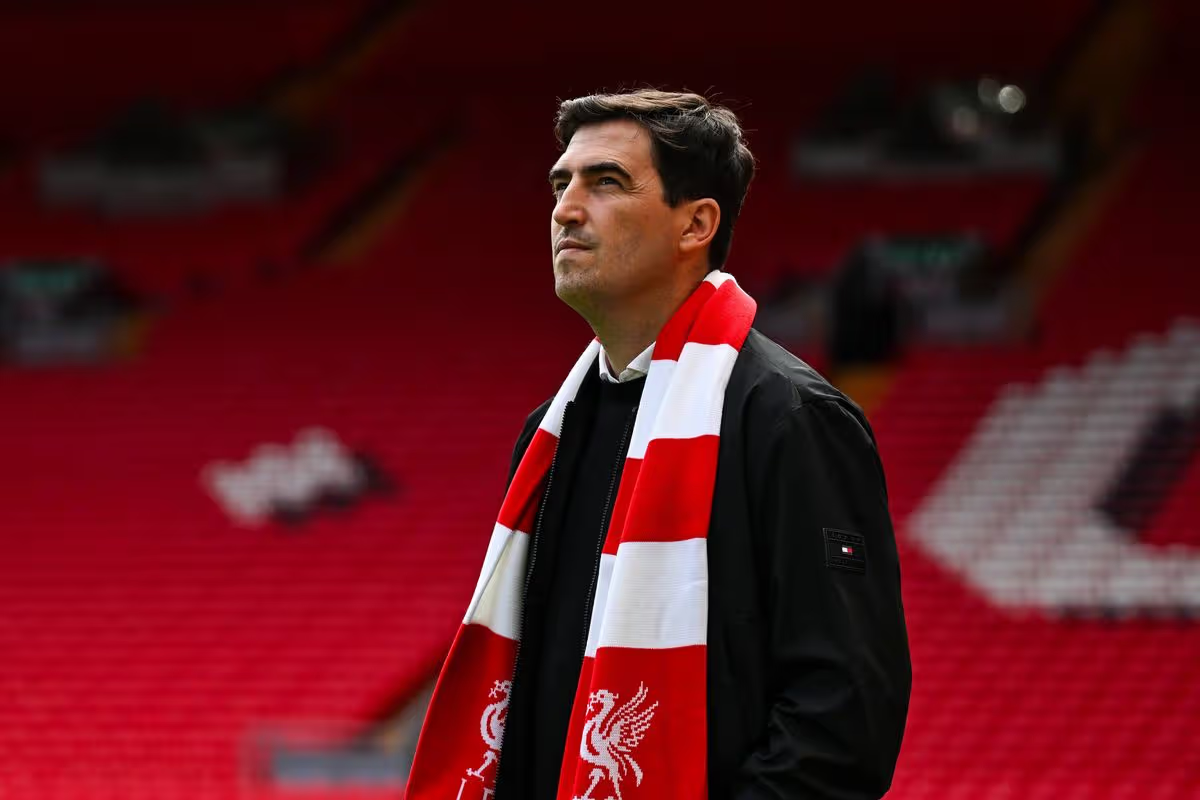
In that respect, Andoni Iraola is an understandable choice to take over the reigns. The 43-year-old transformed Bournemouth into one of Europe’s most front-footed teams during his three seasons in charge, encouraging an adventurous off-the-ball approach that looked to smother the opposition high up the pitch.
Anyone who watched Bournemouth games over the past few seasons would have witnessed their pragmatic style of play. It is worth highlighting that, when they do not have possession of the ball, Bournemouth are arguably the most aggressive club in Europe. According to The Athletic, no team across Europe’s top five leagues covered more distance at a high intensity (20km/h or more) than Bournemouth last season for every 60 minutes the ball was in play.
Liverpool, on the other hand, have generally covered much less distance at high speeds since Slot joined the club.
But the fans would still question how Iraola can scale up his tactical approach to a club where pressure is far greater and expectations are different.
At Bournemouth, he aimed to disrupt and create problems. He will not be able to instill that underdog mentality at one of the biggest clubs in the world.
Iraola will almost certainly look to the transfer market this summer to address any athletic weak spots that he perceives in the squad.
With the increased player quality at Liverpool, we cannot rule out Iraola working with players such as Dominik Szoboszlai or Curtis Jones to help patch any gaps; midfielders who are versatile and can be moulded to unfamiliar positions in the new system.
At Anfield, not all faces are going to be unfamiliar for Iraola. Back in Bournemouth, Milos Kerkez has already worked with Iraola, and is clearly capable of making the step up.
Liverpool’s Virgil Van Dijk might have a hard time adapting to Iraola’s style of defending. With Iraola in charge, Bournemouth’s central defenders did not tend to sprint much more than the average Premier League centre-back, but they are expected to step up and follow runners into midfield in support of team-mates in the press further ahead. It is something that the outgoing Ibrahma Konate is comfortable with, but less so Virgil Van Dijk. The Dutchman happens to be more of a guy run backwards to buffer the pressure, rather than charging up the pitch to engage with opposition strikers.
For Iraola’s Liverpool, the right-back will also be an area where adjustments are required. Jeremie Frimpong has not proven an effective ball-winner so far in the Premier League despite his blistering pace, while Conor Bradley has struggled with a knee injury since the start of 2026, even if he is better suited to an end-to-end full-back role.
As for the midfield, it would not be a surprise to see Iraola explore his options in the transfer market, but he could also look to work with Alexis Mac Allister and Ryan Gravenberch to hone their anticipatory skills.
Further ahead, Florian Wirtz is another player who largely struggled to adapt to the physicality of the Premier League in his debut season, but clearly possesses the energy and desire to carry the ball up the pitch.
Off-ball movement is equally important for Iraola’s midfielders. In order to make the most of opportunities to counter, they must be prepared to join the attack quickly, and to return to position should it break down.
Up top, Liverpool face the huge task of replacing Mohamed Salah this summer. With Iraola now at the helm, they will surely target pacy wide players who can stamp their authority on quick attacks, who will also not shy away from any defensive work.
They are in contact with RB Leipzig over a possible deal for Yan Diomande, an electrifying winger who looks to fit that bill. Rio Ngumoha, still only 17, could be another to grow into the role.
At centre-forward, Hugo Ekitike was devastating on the counter for Eintracht Frankfurt, and showed flashes of his ability to impact the game at speed at Liverpool before a disastrous Achilles injury derailed his season and will keep him out until well into next term. Alexander Isak holds similar potential, but has also been impacted by a stubborn injury.
Given Liverpool’s success in previous years playing hard-hitting transitional football, fans should be quick to get on board. But there are issues to solve with the squad, and tactical ideas to instill, that suggest it could take time for the best of Iraola to appear.