Ali Thameem
Since his debut for the Argentinian national team twenty years ago, Lionel Messi has faced, and overcome, almost every hurdle thrown at him wearing the blue and white jersey.
Two decades, six World Cup editions, and 205 appearances later, and for the very first time in his career, Lionel Messi is set to clash with the birthplace of modern football: England.
Argentina and England have had a bitter, hostile rivalry over the ages, and nobody, especially the Argentinians, have shied away from this bad blood.
Take the fans on the bleachers singing anti-England chants every game, for instance. “And now you see, and now you see, whoever doesn’t jump is English!” This chant is so firmly engrained in Argentina’s football culture that it is used to stir up the players after each World Cup win.
Looking back, perhaps the most memorable moment in this storied rivalry unfolded at the 1986 World Cup at the historic Azteca stadium in Mexico City – when Diego Maradona scored perhaps the most controversial, if not the most popular, goal in World Cup history.
He went on to fire in another strike in the space of four minutes, knocking England out of the quarterfinals, on his way to win Argentina the World Cup.
In his biography, Maradona dedicated that infamous goal to his countrymen who were killed in the Falklands War four years earlier, and described the victory as revenge against the British.
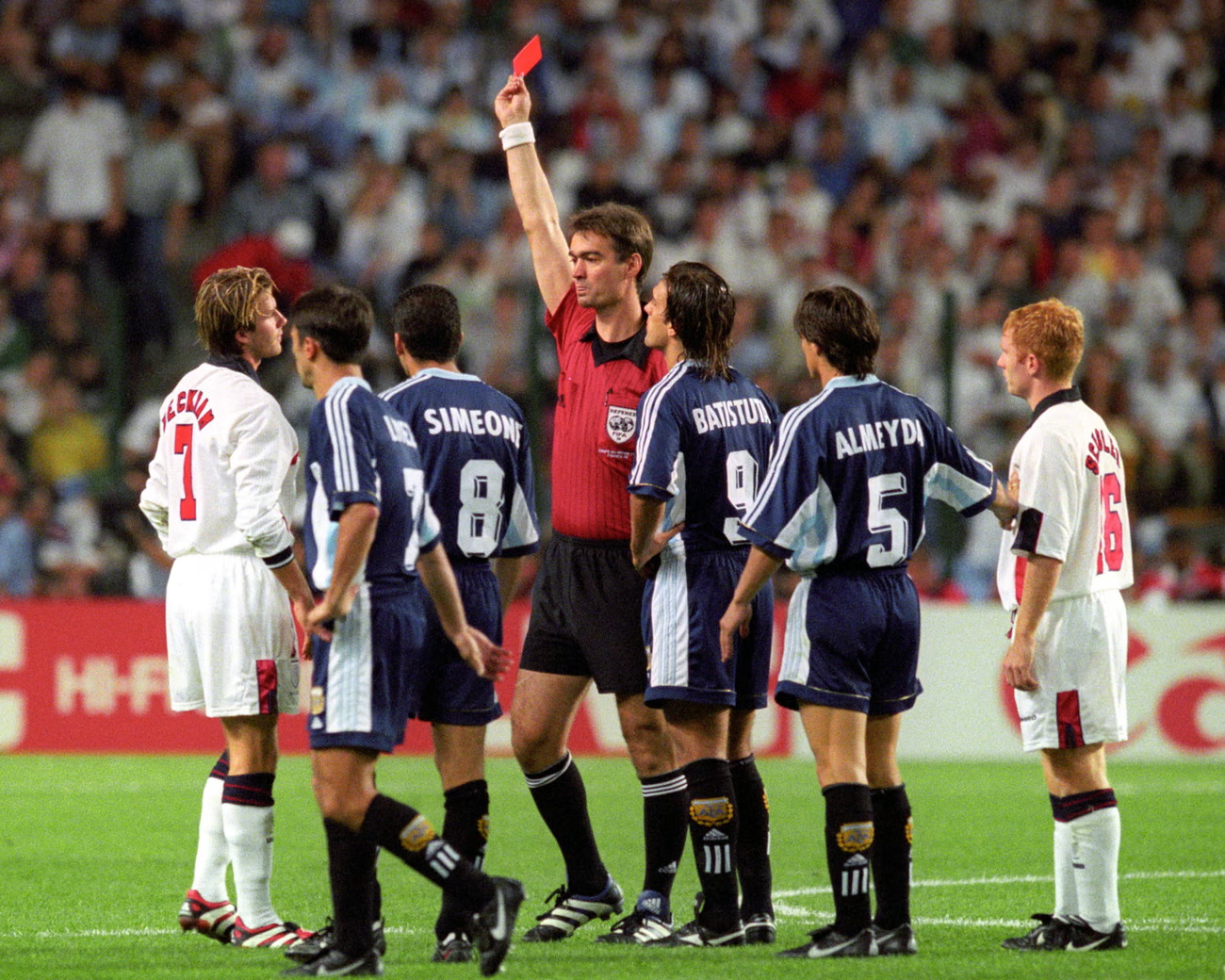
Fast forward twelve years, the rivalry proven yet again to be just as bitter, as Argentina knocked a ten-man England out of the 1998 World Cup in France.
England went on to win a friendly 3-2 against Argentina in 2005, Michael Owen’s brace in the dying minutes helped England with a comeback.
That would be the last time the two nations faced each other, until today.
Just a year after that friendly game in 2005, an 18-year-old boy from the city of Rosario, Argentina, made his World Cup debut in Germany. And yet, just as all of his current teammates, Lionel Messi has never played against The Three Lions.
The decades-old bitterness has not faded, and their seems to be no enmity lost between these two great nations of the game.
Just after the final whistle in their late victory against Switzerland on Sunday’s quarterfinal, Argentina squad gathered in the dressing room – singing their songs, bouncing up and down, banging the tables, singing of their desperation to win their country’s fourth World Cup. They sang and sang, and promised to do it for Lionel Messi, for the late Diego Maradona … and for “Las Malvinas”.
The Falkland Islands, or “Las Malvinas” as the Argentinians call it, is a British oversees territory in the South Atlantic Ocean, off the coast of Argentina. The Argentinians, from the President Javier Milei, to the fans chanting on the stands at their games, wholeheartedly believe the islands belong to them.
“It is never just a football game where England and Argentina are concerned”, writes Oliver Kay for The Athletic. “Their first meeting in 21 years is a World Cup semi-final, meaning the stakes could hardly be higher. But this is a rivalry built around emotions, tensions, controversies and bitter feuds.
So just as Maradona believed, this new crop of Argentinians have ingrained into their minds that this game against England is so much bigger than football.
“We are not here to build him a throne”

Just hours before the semifinal, ITV Sport aired and interview with England boss Thomas Tuchel, who is known for his no-nonsense, tell-it-like-it-is style of wording his thoughts.
“They mean business,” he said. “They are a tough group of players, and they have the mentality, the winning mentality.” Tuchel went on to describe Messi as a “silent killer” who can “kill you while he’s walking”.
The England boss says it is up to him and the players to figure out a way to overcome that “burst of energy” Messi is known to surprise his opponents with, and to “not fall asleep”.
But, Tuchel shares no sentiments with those starry-eyed fans who are dreaming of Messi and Argentina defending the crown. “We are not here to congratulate it, or build him a throne.”
So, yes, in theory, the World Cup is the perfect illustration of “football unites the world”. But within that celebration of global unity, there are fault lines. It is, as Argentina boss Scaloni says, a football match, nothing more.
But that is exactly what Maradona said 40 years ago. And the rest was history.